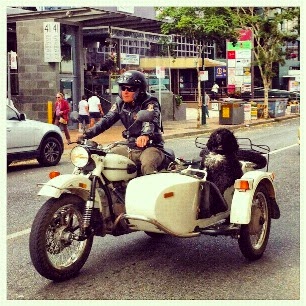
In February 2015 four couples took one of Cuongs Mototorcycle Tours in Vietnam. It was a sidecar tour and it took in the lesser travelled mountain roads between Hanoi and the Chinese border.

We had a guide (Long) and a mechanic (Phu) travelling with
us on a fully catered tour. At around $300 per couple a day for 9 days we only
had to do the sidecar driving and survive the adventure. We are all experienced
Ural sidecar owners but some were only experienced with left side chairs. Our
country girl wives are courageous but were best not to have been fully aware of
the coming challenge!
We mounted up in Hanoi on three 1990 vintage Urals plus Phu
and myself rode two Dneipers of similar age. The bikes were quite reliable and
we only had to deal with regular wear issues as we travelled. The brakes on the
sidecar were disconnected and the bikes had been fitted with adapted Honda disc
brakes front and rear. Motors were the older 650cc of course but we all found
them very torquey and ideal for the rough and steep roads. They were all single
wheel drive bikes as we have in Australia.
Cuong supplied some great ponchos in bright yellow for the
girls in lieu of tonneau covers. These were ideal in view of the cool damp and
rather muddy conditions. Wearing these we christened the girls as “the nuns
from the order of Cuong”.
Temperatures stayed between 6 and 18C day and night with
only around 5 minutes sunshine during the whole tour. There was a constant haze
and inversion cloud and so we wore warm clothes day and night.
We travelled up to 200kms a day and that sometimes took us
from 9am to sunset to complete. No high speed stuff and some quite demanding
stony, rutted, muddy and twisty roads.
From the centre of Hanoi, we headed out on a busy highway
for 20kms. Dealing with the right side of the road, right hand sidecars and a
million mopeds kept us a little stressed until we left the city and turned onto
the mountain roads leaving most of the traffic behind. 200 kms that first day
saw us well clear of the densely populated areas.
Our accommodation was in smaller towns and a couple of
cities. There were hotels, resorts and homestays providing a range of venues.
These were mostly adequate even if a little basic in terms of heating, hot
showers and soft beds for our aching bodies. The best night I thought was a
farm homestay where we all slept in one huge upstairs room in a shed. Single
foam mattresses and light curtains separating each of the couples bit of floor
made for a comfortable night. Their home cooked meals were delicious.
We met the water buffalo bull that ploughs their fields and
were fascinated by their preparation of puffed rice for the markets. This was
done by heating a kilo of rice grain in a cast pressure vessel rotated over a
forge. After 7 minutes the lid was released with a cannon like boom and the
puffed grains were blown out into a net. It would make a great party trick!
Every day we encountered new terrain to ride through. The
first few days it was mostly the fascinating Kaste mountains that rise with
vertical sides from the flat plains. Toward the Chinese border they became
larger and higher with interesting cliff faces. The road surfaces came in all
descriptions. Generally we were on single lane tar roads which required putting
the sidecar wheel off to pass oncoming mopeds, and often we had to stop while
trucks came past. There were few cars and they were the least considerate to
share the road with.
We came into a volcanic area around day 5 and this rock
strewn countryside was amazing to traverse as the difficulty of making roads
through it would have been daunting. Their soils were rich, but boulders
everywhere left only around 50% of the land surface as arable soil. Little
space for machinery and the isolation until recent times meant most of these
villages were poor.
The mountain scenery never failed to be spectacular. Years
of farming have covered the mountain sides with intricate terracing
and the fertile soils are obviously able to support the 90 million Vietnamese
people. The people were always friendly and the children always waved excitedly
as the sidecars approached. Anywhere we stopped a small crowd gathered to
admire our unusual transport. The Ural delay factor did not involve questions
though because very few of the people in these remote areas had enough English.
Many of the roads were based on crushed rock of about 60 –
90mm diameter. If it had then been sealed over with bitumen the surface was
quite good, but anywhere it was not sealed or had broken away the ride was very
rough and jarring. In particular riding down a long 10% grade with no sidecar
wheel brake and the constant jarring had our wrists and elbows crying enough by
the end of the day from fighting the handlebars.
We had a long mountain ascent one day where about 15kms of
road was all wet clay as a road rebuild was underway. It was rough and steep as
well. Consequently the bikes could only just pull second gear as we wound
around corners and over bumps. Dropping back to first gear was no good because
the extra torque would spin the wheel and we lost momentum. It was a delicate
balance and several bikes spun to a standstill having to then go back for a
fresh run up.
We suffered one puncture on our sidecar tyre and had two
electrical wiring issues when old spade connectors were not making good
connection and caused misfires. Phu was expert in all aspects of repair work
and quickly determined the cause and fixed it. One of the bikes had a gearbox
problem on day 4. It turned out that the bearings on the secondary gearbox
shaft were dying. Phu carried a spare box and so he exchanged the gearbox in
less than an hour during our morning coffee break. That night he stripped the
box and located two suitable bearings to replace with. He then swapped the gearbox
back again to the repaired one. “No problem, it’s all in a day's work”.
We crossed a swing bridge one day that was more than
50metres across and wide enough for the sidecars with about 200mm to spare.
This was a neat shortcut and regularly used by large numbers of mopeds. There
were however a couple of concrete bollards at each end to prevent cars and
trucks using the bridge. We had to get past these by cocking the sidecar up and
over them.
Another day we followed a river that needed four deep water crossings.
Phu had a quick recce and went first for us. Alas he drowned it completely in
the middle after it bogged in the gravel. After pushing it clear he was
concerned about us crossing. The water was deep enough and running fast, but
clear enough to see the rocks on the bottom. Our farmer boys checked it out a
bit more, then successfully rode each of the four bikes over without a hitch.
We rode right up to the Chinese border on a couple of spots.
No love lost on China and they pointed out the bridge across the river to China
saying how they had blown it up to keep the Chinese out. Another day we visited
a spectacular waterfall area with a nice lake beneath them. China owned one
side and Vietnam the other. I was not sure who was paddling the boats on the lake,
but there were border surveillance posts watching from high on the mountains
above us in each country.
Whilst long range visibility made distance photos hard to
record detail, we struck a dense fog on the last day that was quite testing to
drive in. It sat on the mountain once we climbed above 1000m and continued for
nearly 2 hours while we drove along at altitudes to 1300 metres. We could only
see 10 to 30 metres ahead and there were no barriers where the roadside dropped
over a cliff. I was not game to look away from the road at all as there were
occasional vehicles appearing from the opposite direction. There were several
occasions when what seemed to be the road ahead materialised into a smooth
roadside verge which led over the cliff. At the last few seconds you could see
the road actually went left or right instead and a quick change of course was
necessary. The other bikes stuck to my taillights and I wondered if they could
have faithfully followed me over a cliff if that was where I took them!
It was an excellent adventure and I would have no hesitation
recommending Cuongs tours to anyone who asked. It is not for the faint hearted
or inexperienced sidecar riders, but it leaves you with lifelong memories and a
deeper appreciation of our lifestyle in Oz.